
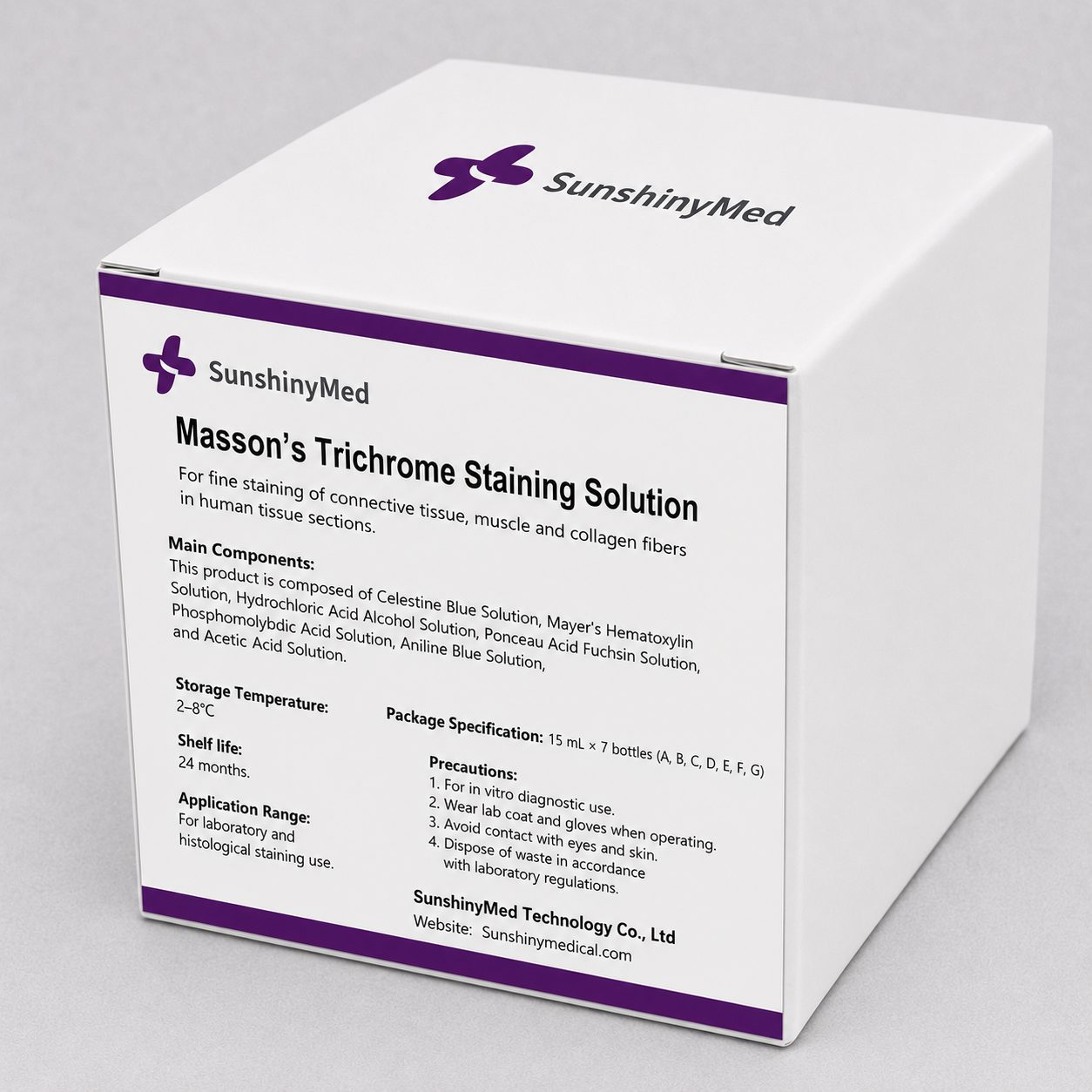


Masson’s Trichrome Staining Solution
Product Information
【Product Name】
Masson's Trichrome Staining Solution
【Main Components】
This product consists of the following reagents:
Reagent A: Celestine Blue Solution — Celestine Blue
Reagent B: Mayer’s Hematoxylin Solution — Hematoxylin
Reagent C: Hydrochloric Acid Alcohol Solution — Hydrochloric Acid and Ethanol
Reagent D: Ponceau S–Acid Fuchsin Staining Solution — Ponceau S and Acid Fuchsin
Reagent E: Phosphomolybdic Acid Solution — Phosphomolybdic Acid
Reagent F: Aniline Blue Staining Solution — Aniline Blue
Reagent G: Acetic Acid Solution — Acetic Acid
【Intended Use】
For staining connective tissue, muscle tissue, and collagen fibers in tissue specimens.
【Principle of the Test】
In a narrow sense, connective tissue contains three types of fibers: collagen fibers, reticular fibers, and elastic fibers. Collagen fibers are the most widely distributed and abundant type of fiber. Masson’s trichrome staining, also known as Masson staining, is one of the most classic methods for connective tissue staining and is a well-established technique for collagen fiber staining.
Trichrome staining generally refers to a staining method that stains cell nuclei while selectively demonstrating collagen fibers and muscle fibers. The staining principle is related to the molecular size of anionic dyes and the permeability of tissues. Molecular size is reflected by molecular weight. Low-molecular-weight dyes can readily penetrate dense tissues with low permeability, whereas high-molecular-weight dyes can only enter loose tissues with high permeability.
Since Light Green and Aniline Blue both have relatively large molecular weights, after Masson’s trichrome staining, muscle fibers appear red, while collagen fibers appear green when Light Green is used or blue when Aniline Blue is used. This method is mainly used to differentiate collagen fibers from muscle fibers.
【Specifications】
9 × 3 mL/bottle; 9 × 5 mL/bottle; 9 × 10 mL/bottle; 9 × 15 mL/bottle; 9 × 30 mL/bottle; 9 × 50 mL/bottle; 9 × 100 mL/bottle; 9 × 250 mL/bottle; 9 × 500 mL/bottle.